|
Selecting Efficient and Cost-effective Heavy Vehicles
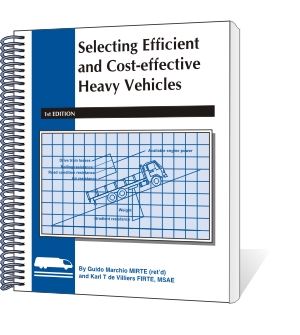 FCS is to compile a range of attested textbooks based on our extensive library of course content developed over 36 years of presenting road transport-related education and training. Hot off the press, the first of the planned series is Selecting Efficient and Cost-effective Heavy Vehicles, written jointly by MIRTE (ret'd) and FIRTE, MSAE. FCS is to compile a range of attested textbooks based on our extensive library of course content developed over 36 years of presenting road transport-related education and training. Hot off the press, the first of the planned series is Selecting Efficient and Cost-effective Heavy Vehicles, written jointly by MIRTE (ret'd) and FIRTE, MSAE.
In many organisations, the major assets consist of working vehicles and the major objective of operating a transport fleet is to optimise profit by minimising costs. This manual has been developed to help achieve that objective and serves as a useful guide of immeasurable benefit to:
- Heavy vehicle fleet operators, large and small
- Heavy vehicle manufacturers
- Heavy vehicle dealers
- Truck body builders
- Trailer builders
- Bus body manufacturers
Contents
Intended for anyone selling, buying or using heavy vehicles, the extensive contents comprises the following nine chapters:
Chapter 1: Terminology and Glossary of Terms
Chapter 2: Matching the Vehicle to the Task
2.1: Introduction
2.2: Vehicle Selection Procedure
2.3: Chassis Dimensions
2.4: Chassis Carrying Capacity
2.5: Vehicle Performance Requirements
2.6: Other Aspects
Chapter 3: Vehicle Types and Combinations
3.1: Rigid (Self-propelled) Vehicles
3.2: Articulated Vehicles
3.3: Combinations of Vehicles
3.4: Semi-trailers
3.5: Drawbar Trailers
Chapter 4: NRTA Vehicle Dimensions, Load Limits and Plating
4.1: Introduction
4.2: Dimensional Limits
4.3: Load Limitations
4.4: Vehicle Plating
Chapter 5: Body Size Calculations and Mass Distribution
5.1: Body Size Calculations
5.2: Mass Distribution
Chapter 6: Chassis and Body Selection
6.1: Chassis Design
6.2: Body Design and Mounting
Chapter 7: Vehicle Performance
7.1: Introduction
7.2: Road Speed
7.3: Engine Performance
7.4: Engine Power Losses
7.5: Drive Train Losses
7.6: Vehicle Operational Performance
7.7: Calculating Gradability
7.8: Cascade Curves and the Road Map of Performance
7.9: Constructing the Road Map of Performance
7.10: Using the Gear Split Chart and the Gradability Chart
7.11: Fuel Consumption and Trip Time Prediction
Chapter 8: Comparing Vehicle Operating Costs
8.1 Introduction
8.2 Fixed (Possession) Costs
8.3 Variable (Running Costs)
8.4 Total Costs
Chapter 9: Vehicle Procurement
9.1: Introduction
9.2: Effective Vehicle Procurement.
Price: R570,00 delivered to your door for the first copy and only R399,00 for each additional copy.
Bank details:
Bank: First National Bank
Branch code: 250655
Account name : Fleet Control Services
Account number: 6275 6381 803
To order (request a pro forma invoice) or for further information please e-mail . Karl de Villiers may also be contacted on landline 021 887 9526 or cellphone 071 264 3909 or fax 086 672 6862.
Download an
|
